
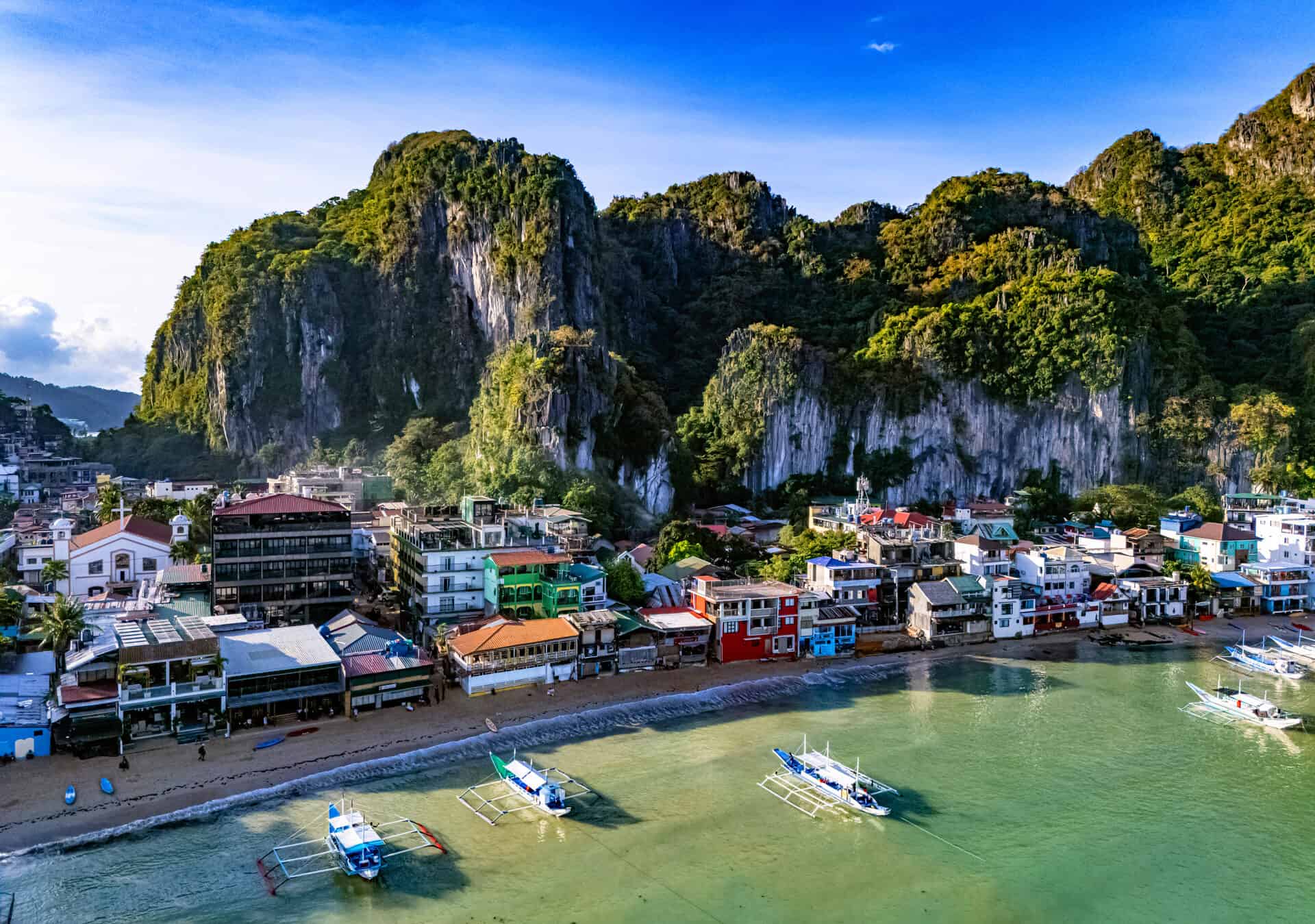
El Nido, on the island of Palawan, is a true tropical paradise. Turquoise lagoons, fine sand beaches, crystal-clear water, friendly locals, sunny weather… everything is there for a dream vacation. That said, as always, perfection isn’t of this world. There are a few things you should know before arriving to avoid any bad surprises and make your stay a truly memorable one.
1) Withdrawing money in El Nido
For a long time, there was no ATM at all in El Nido, which forced travelers to plan ahead by withdrawing cash in Puerto Princesa. Good news: the situation has changed a lot. Several ATMs are now available in town, and a few banks have set up there (BPI, BDO, Metrobank).
The one piece of advice to remember: always go for bank ATMs, which charge a fixed fee of around 250 PHP per withdrawal, rather than the very common “private” ATMs that take 10 to 11.5% of the amount. For everything you need to know, head over here: Where can you withdraw money in El Nido?
2) Finding a place to stay in El Nido
During the high season (December to March/April), El Nido is very busy and finding last-minute accommodation can prove tricky. You’ll probably find something, but maybe outside your initial budget.
To avoid any bad surprises, it’s better to book your hotel in advance. You can check out our selection here: Booking.com — Hotels in El Nido. And don’t hesitate to contact the hotel directly on Facebook Messenger or WhatsApp before booking — these are the most-used channels in the Philippines, usually far more responsive than email for getting a clear answer.
3) Internet and Wi-Fi in El Nido
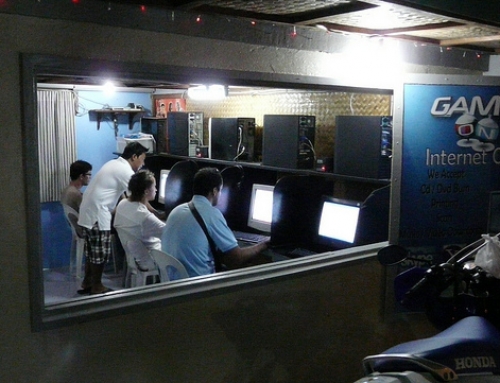
Here too, the situation has improved enormously in recent years. Most hotels, cafés and restaurants now offer free Wi-Fi, and 4G/5G coverage is available almost everywhere thanks to the operators Globe Telecom and Smart Communications, whose prepaid SIM cards are very affordable.
That said, you are on an island at the edge of the Philippines: don’t expect a connection as fast as in Europe or in Manila. For all the details on your options (hotel Wi-Fi, local SIM, eSIM, Starlink for demanding nomads), see: Where to find a good Internet or Wi-Fi connection in El Nido?
4) Medical care in El Nido
Nobody likes to think about it on vacation, but it’s better to know: for a long time, El Nido didn’t have any hospital infrastructure. The situation has improved significantly with the opening of the El Nido Community Hospital, which handles many common cases. For the detailed list of useful contacts (doctors, clinics, pharmacies), see our dedicated article: Where to find a doctor in El Nido?
For very specialized care or serious emergencies, patients are still transferred by van to Puerto Princesa (about 5 hours away), where more complete facilities are available. As with any trip, good travel insurance covering overseas medical expenses remains essential. For long-term travelers and digital nomads, SafetyWing is a popular option with online sign-up in just a few minutes.
5) The streets of El Nido
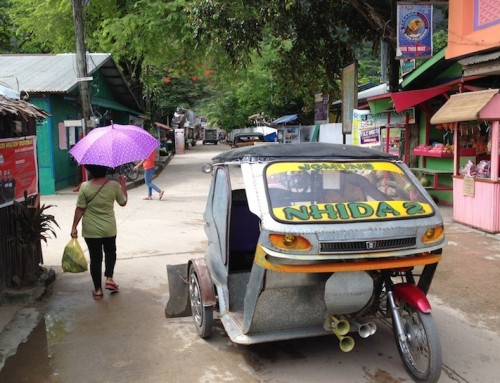
You’ll quickly notice that there are no “official” sidewalks in El Nido. But that doesn’t mean you can walk in the middle of the street! There’s a lot of traffic in town — motorbikes, tricycles, cars, trucks — and walking right down the middle of the road disturbs drivers and exposes you to accidents.
The right reflex: watch the locals. You’ll see they walk on the sides of the road and stay alert to vehicles coming from behind (they step a bit further aside when needed). By doing the same, you’ll avoid being honked at every 30 seconds and you’ll gain in peace of mind.
6) Power cuts in El Nido
Until October 2014, El Nido wasn’t even powered 24/7 — electricity was only available between 3pm and 6am. Today, you have continuous power, but blackouts are still quite frequent. Most of the time they last a few hours, sometimes a bit longer, often linked to tropical storms or maintenance work.
The real discomfort is at night: if your fan stops working, the heat can quickly become stifling. The best-equipped hotels have their own generator, so if you’re staying in a higher-end place, you’ll barely notice these outages.
7) The cost of living in El Nido
Let’s be transparent: El Nido is probably one of the most expensive places in the Philippines. Transport, restaurants, bars, hotels — everything costs a bit more than elsewhere on Palawan, simply because it’s a very touristy destination. Of course, this is still nothing compared to the touristy destinations in Europe or North America.
A few good habits to keep your budget under control: favor the local karinderyas (small neighborhood eateries) in addition to the pricier beachside restaurants, always ask whether credit card is accepted before ordering (few places take it, and those that do often add a 3 to 5% commission), and withdraw your cash at a bank ATM rather than a “private” ATM (see above).
8) El Nido remains a tropical paradise
These few practical points aside, El Nido fully delivers on its promise: breathtaking landscapes, warm welcome, simplicity of life. After your first island-hopping tour, you’ll most likely be reassured that you made the right choice.
By organizing yourself well (and in particular by favoring private tours or off-the-beaten-path itineraries), you’ll be able to fully enjoy the beauty of the place without being drowned in the crowd. Chances are that as you leave El Nido, you’ll have only one wish: to come back as soon as possible!
Conclusion
If you think we’ve forgotten something important to know before arriving in El Nido, feel free to let us know in the comments. And if we can help you organize your trip or if you have questions, you can use this form to get in touch. We’ll be delighted to help make your stay in El Nido a great memory!
“Chances are that when you’ll leave El Nido, you’ll have only one wish: coming back!“ I can totally relate to that… jajaja :)
Thanks for your message, Ana. Hope to see you back there one of these days! :)
Hi. Is there a place on el nido where we can rent underwater camera and water equipment like snorkles?
Yes they rent Go Pro cameras in town. Snorkels are provided free by island tour operators on board the boat.
Hi Rosie,
We do have masks and snorkels for rent, but for the underwater camera, it might be a little difficult to find at the time being.
Cheers,
Pierre
Just came across this and wanted to point out some updated info. There are now two banks that have ATMs here which take foreign cards. A full BPI branch opened in June 2016, and RCBC has two ATMs at the town hall.
Additionally, you can purchase a Globe LTE sim card, and if your phone has LTE capabilities then you wont have an issue with connecting to the internet.
Finally, there’s a GoPro shop close to Squidos restaurant.
thanks for the update! We’ll be visiting the place in November, cant wait!!
Thanks for the update Kevin. Some ATMs did arrive in El Nido, which is great. Nonetheless, from repeated experience in the last couple of years, they are very often empty and unavailable starting at the end of the afternoon (especially during the high season).
I am planning to go to el nido this 6th Sept.. What u guys think of the weather that time? Kinda worried..
Hi Natasha,
It’s still the wet season, but it really depends. You can have a great weather, or it can be covered, raining or even have a typhoon. It’s quite impossible to predict… That being said, generally speaking, Palawan is not as rainy as some other parts of the Philippines, which makes it also enjoyable during the low season. A lot of Korean tourists for example come during the months of July, August and September.
is it really that hard to find an accomodation to stay in el nido?
Hi Maj,
During high season, yes.
Hi! I’m planning to go to El Nido by 4th week of February. Is it high season already?
Thank you!
Hi Leo,
Yes it is! :)
hey my family and i are planning to go in May of this year i just wanted to ask as far as booking and everything, how do i pay online coz the frequency that they have as an option at the checkout is only Php? we’re from texas.
Hi Eric,
You can pay online using a PayPal account or your credit/debit card. Please see here: https://www.elnidoparadise.com/booking
The prices are all in PHP but the amount will be converted into your own currency by PayPal when you checkout.
Cheers,
Pierre
Is mineral water really expensive in el nido?
Hi Eric,
No worries about that, local drinking water is quite cheap. :)
Hi how much the usual rate for a private tour for itinerary A and C?
Thanks
Hi Yvette,
The rate for public Combo Tour A&C is P2,000/person. You can find all details about this tour here: Combo Tour A & C.
Hi there, we just got back here in Manila after 4 days stay in EL Nido. Indeed, it is a paradise. But please be reminded everyone not to eat seafood and always always bring bottled water. My bf and got hospitalized due to diarrhea and probably food poison. When we arrived at DR reyes’ clinic, there were few tourists as well who had the same complaint.
My bf was too weak already and dehydrated thus we decided to admit him, for only 2 hours the doctor asked us to pay Php10,200. :(
We noticed that’s the amount they ask from the tourists especially if you are a foreigner. It is too sad coz we feel like they take advantage of the tourists.
Hi Kaye,
It can indeed be difficult to find a doctor in El Nido… In addition to Dr Reyes office, there’s also the Medical Center, located at the entry of town when you come from Corong-Corong. This is probably a better option if you’re looking for a medical treatment in El Nido. Also, there’s the Rural Health Center, located next to the covered gym at the center of town.
About the food and water: never drink water from the tap in El Nido (or in the Philippines)! But normally, in good restaurants, the sea products should be fresh and good to eat.